The lion (Panthera leo) is a large felid of the genus Panthera native to Africa and India. It has a muscular, deep-chested body, short, rounded head, round ears, and a hairy tuft at the end of its tail. It is sexually dimorphic; adult male lions are larger than females and have a prominent mane. It is a social species, forming groups called prides. A lion's pride consists of a few adult males, related females, and cubs. Groups of female lions usually hunt together, preying mostly on large ungulates. The lion is an apex and keystone predator; although some lions scavenge when opportunities occur and have been known to hunt humans, the species typically does not.


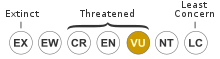


Typically, the lion inhabits grasslands and savannas, but is absent in dense forests. It is usually more diurnal than other wild cats, but when persecuted, it adapts to being active at night and at twilight. During the Neolithic period, the lion ranged throughout Africa, Southeast Europe, the Caucasus, and Western and South Asia, but it has been reduced to fragmented populations in sub-Saharan Africa and one population in western India. It has been listed as Vulnerable on the IUCN Red List since 1996 because populations in African countries have declined by about 43% since the early 1990s. Lion populations are untenable outside designated protected areas. Although the cause of the decline is not fully understood, habitat loss and conflicts with humans are the greatest causes for concern.
One of the most widely recognised animal symbols in human culture, the lion has been extensively depicted in sculptures and paintings, on national flags, and in contemporary films and literature. Lions have been kept in menageries since the time of the Roman Empire and have been a key species sought for exhibition in zoological gardens across the world since the late 18th century. Cultural depictions of lions were prominent in Ancient Egypt, and depictions have occurred in virtually all ancient and medieval cultures in the lion's historic and current range.
Etymology
The word 'lion' is derived from Latin: leo[4] and Ancient Greek: λέων (leon).[5] The word lavi (Hebrew: לָבִיא) may also be related.[6] The generic name Panthera is traceable to the classical Latin word 'panthēra' and the ancient Greek word πάνθηρ 'panther'.[7] Panthera is phonetically similar to the Sanskrit word पाण्डर pând-ara meaning 'pale yellow, whitish, white'.[8]
Taxonomy

Felis leo was the scientific name used by Carl Linnaeus in 1758, who described the lion in his work Systema Naturae.[3] The genus name Panthera was coined by Lorenz Oken in 1816.[13] Between the mid-18th and mid-20th centuries, 26 lion specimens were described and proposed as subspecies, of which 11 were recognised as valid in 2005.[1] They were distinguished mostly by the size and colour of their manes and skins.[14]
Subspecies

In the 19th and 20th centuries, several lion type specimens were described and proposed as subspecies, with about a dozen recognised as valid taxa until 2017.[1] Between 2008 and 2016, IUCN Red List assessors used only two subspecific names: P. l. leo for African lion populations, and P. l. persica for the Asiatic lion population.[2][15][16] In 2017, the Cat Classification Task Force of the Cat Specialist Group revised lion taxonomy, and recognises two subspecies based on results of several phylogeographic studies on lion evolution, namely:[17]
- P. l. leo (Linnaeus, 1758) − the nominate lion subspecies includes the Asiatic lion, the regionally extinct Barbary lion, and lion populations in West and northern parts of Central Africa.[17] Synonyms include P. l. persica (Meyer, 1826), P. l. senegalensis (Meyer, 1826), P. l. kamptzi (Matschie, 1900), and P. l. azandica (Allen, 1924).[1] Multiple authors referred to it as 'northern lion' and 'northern subspecies'.[18][19]
- P. l. melanochaita (Smith, 1842) − includes the extinct Cape lion and lion populations in East and Southern African regions.[17] Synonyms include P. l. somaliensis (Noack 1891), P. l. massaica (Neumann, 1900), P. l. sabakiensis (Lönnberg, 1910), P. l. bleyenberghi (Lönnberg, 1914), P. l. roosevelti (Heller, 1914), P. l. nyanzae (Heller, 1914), P. l. hollisteri (Allen, 1924), P. l. krugeri (Roberts, 1929), P. l. vernayi (Roberts, 1948), and P. l. webbiensis (Zukowsky, 1964).[1][14] It has been referred to as 'southern subspecies' and 'southern lion'.[19]
However, there seems to be some degree of overlap between both groups in northern Central Africa. DNA analysis from a more recent study indicates, that Central African lions are derived from of both northern and southern lions, as they cluster with P. leo leo in mtDNA-based phylogenies whereas their genomic DNA indicates a closer relationship with P. leo melanochaita.[20]
Lion samples from some parts of the Ethiopian Highlands cluster genetically with those from Cameroon and Chad, while lions from other areas of Ethiopia cluster with samples from East Africa. Researchers therefore assume Ethiopia is a contact zone between the two subspecies.[21]Genome-wide data of a wild-born historical lion sample from Sudan showed that it clustered with P. l. leo in mtDNA-based phylogenies, but with a high affinity to P. l. melanochaita. This result suggested that the taxonomic position of lions in Central Africa may require revision.[22]
Fossil records

Other lion subspecies or sister species to the modern lion existed in prehistoric times:[23]
- P. l. sinhaleyus was a fossil carnassial excavated in Sri Lanka, which was attributed to a lion. It is thought to have become extinct around 39,000 years ago.[24]
- P. leo fossilis was larger than the modern lion and lived in the Middle Pleistocene. Bone fragments were excavated in caves in the United Kingdom, Germany, Italy and Czech Republic.[25][26]
- P. spelaea, or the cave lion, lived in Eurasia and Beringia during the Late Pleistocene. It became extinct due to climate warming or human expansion latest by 11,900 years ago.[27] Bone fragments excavated in European, North Asian, Canadian and Alaskan caves indicate that it ranged from Europe across Siberia into western Alaska.[28] It likely derived from P. fossilis,[29] and was genetically isolated and highly distinct from the modern lion in Africa and Eurasia.[30][29] It is depicted in Paleolithic cave paintings, ivory carvings, and clay busts.[31]
- P. atrox, or the American lion, ranged in the Americas from Canada to possibly Patagonia.[32] It arose when a cave lion population in Beringia became isolated south of the Cordilleran Ice Sheet about 370,000 years ago.[33][34] A fossil from Edmonton dates to 11,355 ± 55 years ago.[35]
Evolution

blue P. atrox
green P. leo
Maximal range of the modern lion
and its prehistoric relatives
in the late Pleistocene
The Panthera lineage is estimated to have genetically diverged from the common ancestor of the Felidae around 9.32 to 4.47 million years ago to 11.75 to 0.97 million years ago,[9][36][37] and the geographic origin of the genus is most likely northern Central Asia.[38] Results of analyses differ in the phylogenetic relationship of the lion; it was thought to form a sister group with the jaguar (P. onca) that diverged 3.46 to 1.22 million years ago,[9] but also with the leopard (P. pardus) that diverged 3.1 to 1.95 million years ago[11][12] to 4.32 to 0.02 million years ago. Hybridisation between lion and snow leopard (P. uncia) ancestors possibly continued until about 2.1 million years ago.[37] The lion-leopard clade was distributed in the Asian and African Palearctic since at least the early Pliocene.[38] The earliest fossils recognisable as lions were found at Olduvai Gorge in Tanzania and are estimated to be up to 2 million years old.[36]
Estimates for the divergence time of the modern and cave lion lineages range from 529,000 to 392,000 years ago based on mutation rate per generation time of the modern lion. There is no evidence for gene flow between the two lineages, indicating that they did not share the same geographic area.[22] The Eurasian and American cave lions became extinct at the end of the last glacial period without mitochondrial descendants on other continents.[30][39][40] The modern lion was probably widely distributed in Africa during the Middle Pleistocene and started to diverge in sub-Saharan Africa during the Late Pleistocene. Lion populations in East and Southern Africa became separated from populations in West and North Africa when the equatorial rainforest expanded 183,500 to 81,800 years ago.[41] They shared a common ancestor probably between 98,000 and 52,000 years ago.[22] Due to the expansion of the Sahara between 83,100 and 26,600 years ago, lion populations in West and North Africa became separated. As the rainforest decreased and thus gave rise to more open habitats, lions moved from West to Central Africa. Lions from North Africa dispersed to southern Europe and Asia between 38,800 and 8,300 years ago.[41]
Extinction of lions in southern Europe, North Africa and the Middle East interrupted gene flow between lion populations in Asia and Africa. Genetic evidence revealed numerous mutations in lion samples from East and Southern Africa, which indicates that this group has a longer evolutionary history than genetically less diverse lion samples from Asia and West and Central Africa.[42] A whole genome-wide sequence of lion samples showed that samples from West Africa shared alleles with samples from Southern Africa, and samples from Central Africa shared alleles with samples from Asia. This phenomenon indicates that Central Africa was a melting pot of lion populations after they had become isolated, possibly migrating through corridors in the Nile Basin during the early Holocene.[22]
Hybrids
In zoos, lions have been bred with tigers to create hybrids for the curiosity of visitors or for scientific purpose.[43][44] The liger is bigger than a lion and a tiger, whereas most tigons are relatively small compared to their parents because of reciprocal gene effects.[45][46] The leopon is a hybrid between a lion and leopard.[47]
Description

.jpg)
The lion is a muscular, deep-chested cat with a short, rounded head, a reduced neck and round ears. Its fur varies in colour from light buff to silvery grey, yellowish red and dark brown. The colours of the underparts are generally lighter. A new-born lion has dark spots, which fade as the cub reaches adulthood, although faint spots often may still be seen on the legs and underparts. The lion is the only member of the cat family that displays obvious sexual dimorphism. Males have broader heads and a prominent mane that grows downwards and backwards covering most of the head, neck, shoulders, and chest. The mane is typically brownish and tinged with yellow, rust and black hairs.[48][49]
The tail of all lions ends in a dark, hairy tuft that in some lions conceals an approximately 5 mm (0.20 in)-long, hard "spine" or "spur" that is formed from the final, fused sections of tail bone. The functions of the spur are unknown. The tuft is absent at birth and develops at around 51⁄2 months of age. It is readily identifiable by the age of seven months.[50]
Of the living felid species, the lion is rivaled only by the tiger in length, weight, and height at the shoulder.[51] Its skull is very similar to that of the tiger, although the frontal region is usually more depressed and flattened, and has a slightly shorter postorbital region and broader nasal openings than those of the tiger. Due to the amount of skull variation in the two species, usually only the structure of the lower jaw can be used as a reliable indicator of species.[52][53]
Skeletal muscles of the lion make up 58.8% of its body weight and represents the highest percentage of muscles among mammals.[54][55]
Size
The size and weight of adult lions varies across global range and habitats.[56][57][58][59] Accounts of a few individuals that were larger than average exist from Africa and India.[48][60][61][62]
Mane
_male_6y.jpg)

The male lion's mane is the most recognisable feature of the species.[14] It may have evolved around 320,000–190,000 years ago.[64] It starts growing when lions are about a year old. Mane colour varies and darkens with age; research shows its colour and size are influenced by environmental factors such as average ambient temperature. Mane length apparently signals fighting success in male–male relationships; darker-maned individuals may have longer reproductive lives and higher offspring survival, although they suffer in the hottest months of the year. The presence, absence, colour and size of the mane are associated with genetic precondition, sexual maturity, climate and testosterone production; the rule of thumb is that a darker, fuller mane indicates a healthier animal. In Serengeti National Park, female lions favour males with dense, dark manes as mates. Male lions usually aim for the backs or hindquarters of rivals, rather than their necks.[65][66] Cool ambient temperature in European and North American zoos may result in a heavier mane.[67] Asiatic lions usually have sparser manes than average African lions.[68]
Almost all male lions in Pendjari National Park are either maneless or have very short manes.[69] Maneless lions have also been reported in Senegal, in Sudan's Dinder National Park and in Tsavo East National Park, Kenya.[70] The original male white lion from Timbavati in South Africa was also maneless. The hormone testosterone has been linked to mane growth; castrated lions often have little to no mane because the removal of the gonads inhibits testosterone production.[71] Increased testosterone may be the cause of maned lionesses reported in northern Botswana.[72]
Colour variation
The white lion is a rare morph with a genetic condition called leucism which is caused by a double recessive allele. It is not albino; it has normal pigmentation in the eyes and skin. White lions have occasionally been encountered in and around Kruger National Park and the adjacent Timbavati Private Game Reserve in eastern South Africa. They were removed from the wild in the 1970s, thus decreasing the white lion gene pool. Nevertheless, 17 births have been recorded in five prides between 2007 and 2015.[73] White lions are selected for breeding in captivity.[74] They have reportedly been bred in camps in South Africa for use as trophies to be killed during canned hunts.[75]

No comments: