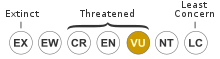
The leopard (Panthera pardus) is one of the five extant species in the genus Panthera, a member of the cat family, Felidae.[4] It occurs in a wide range in sub-Saharan Africa, in some parts of Western and Central Asia, Southern Russia, and on the Indian subcontinent to Southeast and East Asia. It is listed as Vulnerable on the IUCN Red List because leopard populations are threatened by habitat loss and fragmentation, and are declining in large parts of the global range. The leopard is considered locally extinct in Hong Kong, Singapore, South Korea, Jordan, Morocco, Togo, the United Arab Emirates, Uzbekistan, Lebanon, Mauritania, Kuwait, Syria, Libya, Tunisia and most likely in North Korea, Gambia, Laos, Lesotho, Tajikistan, Vietnam and Israel.[3] Contemporary records suggest that the leopard occurs in only 25% of its historical global range.[5][6]
.jpg)


Compared to other wild cats, the leopard has relatively short legs and a long body with a large skull. Its fur is marked with rosettes. It is similar in appearance to the jaguar (Panthera onca), but has a smaller, lighter physique, and its rosettes are generally smaller, more densely packed and without central spots. Both leopards and jaguars that are melanistic are known as black panthers. The leopard is distinguished by its well-camouflaged fur, opportunistic hunting behaviour, broad diet, strength, and its ability to adapt to a variety of habitats ranging from rainforest to steppe, including arid and montane areas. It can run at speeds of up to 58 km/h (36 mph).[7] The earliest known leopard fossils excavated in Europe are estimated 600,000 years old, dating to the late Early Pleistocene.[2] Leopard fossils were also found in Japan[8] and Sumatra.[9]
Etymology
The English name 'leopard' comes from Old French: leupart or Middle French: liepart, that derives from Latin: leopardus and Ancient Greek: λέοπάρδος (leopardos). Leopardos could be a compound of λέων (leōn), meaning lion, and πάρδος (pardos).[10][11][12] The word λέοπάρδος originally referred to a cheetah (Acinonyx jubatus).[13]
'Panther' is another common name, derived from Latin: panther and Ancient Greek: πάνθηρ (pánthēr);[10] The generic name Panthera originates in Latin: panthera, which refers to a hunting net for catching wild beasts that were used by the Romans in combats.[14] The phonetically similar Sanskrit: पाण्डर (pând-ara) means pale yellow, whitish or white.[15] The specific name Latin: pardus refers to a male panther.[16] The word pardus is thought to originate from Ancient Greek: παρδάλωτός (pardalotόs) meaning spotted like a leopard.[17]
Characteristics
.jpg)

The leopard's fur is generally soft and thick, notably softer on the belly than on the back.[18] Its skin colour varies between individuals from pale yellowish to dark golden with dark spots grouped in rosettes. Its belly is whitish and its ringed tail is shorter than its body. Its pupils are round.[19] Leopards living in arid regions are pale cream, yellowish to ochraceous and rufous in colour; those living in forests and mountains are much darker and deep golden. Spots fade toward the white underbelly and the insides and lower parts of the legs.[20] Rosettes are circular in East African leopard populations, and tend to be squarish in Southern African and larger in Asian leopard populations. The fur tends to be grayish in colder climates, and dark golden in rain forest habitats.[7] The pattern of the rosettes is unique in each individual.[21][22] This pattern is thought to be an adaptation to dense vegetation with patchy shadows, where it serves as camouflage.[23]
Its white-tipped tail is about 60–100 cm (23.6–39.4 in) long, white underneath and with spots that form incomplete bands toward the tail's end.[24] The guard hairs protecting the basal hairs are short, 3–4 mm (0.1–0.2 in) in face and head, and increase in length toward the flanks and the belly to about 25–30 mm (1.0–1.2 in). Juveniles have woolly fur, and appear to be dark-coloured due to the densely arranged spots.[21][25] Its fur tends to grow longer in colder climates.[26] The leopard's rosettes differ from those of the jaguar (Panthera onca), which are darker and with smaller spots inside.[19]
The leopard has a diploid chromosome number of 38.[27] The chromosomes include four acrocentric, five metacentric, seven submetacentric and two telocentric pairs.[28]
Size and weight
The leopard is sexually dimorphic with males larger and heavier than females.[24] It is muscular, with relatively short limbs and a broad head. Males stand 60–70 cm (23.6–27.6 in) at the shoulder, while females are 57–64 cm (22.4–25.2 in) tall. The head-and-body length ranges between 90 and 196 cm (2 ft 11.4 in and 6 ft 5.2 in) with a 66 to 102 cm (2 ft 2.0 in to 3 ft 4.2 in) long tail. Sizes vary geographically.[26] Males weigh 37–90 kg (81.6–198.4 lb), and females 28–60 kg (61.7–132.3 lb).[25][29] Some leopards in North Africa allegedly were as large as Barbary lions (Panthera leo leo). In 1913, an Algerian newspaper reported a leopard killed that allegedly measured about 275 cm (9 ft 0 in) in total length.[30] The maximum weight of a wild leopard in Southern Africa was about 96 kg (212 lb). It measured 262 cm (8 ft 7.1 in).[31] An Indian leopard killed in Himachal Pradesh in 2016 measured 261 cm (8 ft 6.8 in) with an estimated weight of 78.5 kg (173.1 lb); it was perhaps the largest known wild leopard in india.[32][33]
The largest skull of a leopard was recorded in India in 1920 and measured 28 cm (11.0 in) in basal length, 20 cm (7.9 in) in breadth, and weighed 1,000 g (2 lb 4 oz). The skull of a African leopard measured 285.8 mm (11.25 in) in basal length, and 181.0 mm (7.125 in) in breadth, and weighed 790 g (1 lb 12 oz).[34]
Variant colouration

Melanistic leopards are also called black panthers. Melanism in leopards is caused by a recessive allele and inherited as a recessive trait.[35] Interbreeding in melanistic leopards produces a significantly smaller litter size than is produced by normal pairings.[36] The black leopard is common foremost in tropical and subtropical moist forests like the equatorial rainforest of the Malay Peninsula and the tropical rainforest on the slopes of some African mountains such as Mount Kenya.[37] Between January 1996 and March 2009, leopards were photographed at 16 sites in the Malay Peninsula in a sampling effort of more than 1,000 camera trap nights. Of the 445 photographs of melanistic leopards, 410 were taken in study sites south of the Kra Isthmus, where the non-melanistic morph was never photographed. These data indicate the near-fixation of the dark allele in the region. The expected time for the fixation of this recessive allele due to genetic drift alone ranged from about 1,100 years to about 100,000 years.[38][39] Pseudomelanistic leopards have also been reported.[40]
In India, nine pale and white leopards were reported between 1905 and 1967.[41] Leopards exhibiting erythrism were recorded between 1990 and 2015 in South Africa's Madikwe Game Reserve and in Mpumalanga. The cause of this morph, known as a "strawberry leopard" or "pink panther", is not well understood.[42]
Taxonomy

Felis pardus was the scientific name proposed by Carl Linnaeus in 1758.[43] The generic name Panthera was first used by Lorenz Oken in 1816, who included all the known spotted cats into this group.[44] Oken's classification was not widely accepted, and Felis or Leopardus was used as the generic name until the early 20th century.[45]
The leopard was designated as the type species of Panthera by Joel Asaph Allen in 1902.[46] In 1917, Reginald Innes Pocock also subordinated the tiger (P. tigris), lion (P. leo), and jaguar (P. onca) to Panthera.[47][48]
Subspecies
Following Linnaeus' first description, 27 leopard subspecies were proposed by naturalists between 1794 and 1956. Since 1996, only eight subspecies have been considered valid on the basis of mitochondrial analysis.[49] Later analysis revealed a ninth valid subspecies, the Arabian leopard.[50]
In 2017, the Cat Classification Task Force of the Cat Specialist Group recognized the following eight subspecies as valid taxa:[4]
.jpg)


Results of an analysis of molecular variance and pairwise fixation index of 182 African leopard museum specimens published in 2017 showed that some African leopards exhibit higher genetic differences than certain Asian leopards which are recognized as subspecies.[62]
Evolution

Results of phylogenetic studies based on nDNA and mtDNA analysis showed that the last common ancestor of the Panthera and Neofelis genera is thought to have lived about 6.37 million years ago. Neofelis diverged about 8.66 million years ago from the Panthera lineage. The tiger diverged about 6.55 million years ago, followed by the snow leopard about 4.63 million years ago and the leopard about 4.35 million years ago. The leopard is a sister taxon to a clade within Panthera, consisting of the lion and the jaguar.[63][64]
Results of a phylogenetic analysis of chemical secretions amongst cats indicated that the leopard is closely related to the lion.[67] The geographic origin of the Panthera is most likely northern Central Asia. The leopard-lion clade was distributed in the Asian and African Palearctic since at least the early Pliocene.[68] The leopard-lion clade diverged 3.1–1.95 million years ago.[65][66] Additionally, a 2016 study revealed that the mitochondrial genomes of the leopard, lion and snow leopard are more similar to each other than their nuclear genomes, indicating that their ancestors hybridized with the snow leopard at some point in their evolution.[69]
Fossils of leopard ancestors were excavated in East Africa and South Asia, dating back to the Pleistocene between 2 and 3.5 million years ago. The modern leopard is suggested to have evolved in Africa about 0.5 to 0.8 million years ago and to have radiated across Asia about 0.2 and 0.3 million years ago.[50] Fossil cat teeth collected in Sumatra's Padang Highlands were assigned to the leopard. It has since been hypothesized that it became extirpated on the island due to the Toba eruption about 75,000 years ago,[70] and due to competition with the Sunda clouded leopard (Neofelis diardi) and the dhole (Cuon alpinus).[9]
In Europe, the leopard occurred at least since the Pleistocene. Leopard-like fossil bones and teeth possibly dating to the Pliocene were excavated in Perrier in France, northeast of London, and in Valdarno, Italy. Until 1940, similar fossils dating back to the Pleistocene were excavated mostly in loess and caves at 40 sites in Europe, including Furninha Cave near Lisbon, Genista Caves in Gibraltar, and Santander Province in northern Spain to several sites across France, Switzerland, Italy, Austria, Germany, in the north up to Derby in England, in the east to Přerov in the Czech Republic and the Baranya in southern Hungary,[71] Leopard fossils dating to the Late Pleistocene were found in Biśnik Cave in south-central Poland.[72] The oldest known leopard fossils excavated in Europe are about 600,000 years old and were found in the Grotte du Vallonnet in France and near Mauer in Germany.[2] Four European Pleistocene leopard subspecies were proposed. P. p. begoueni from the beginning of the Early Pleistocene was replaced about 0.6 million years ago by P. p. sickenbergi, which in turn was replaced by P. p. antiqua around 0.3 million years ago. The most recent, P. p. spelaea, appeared at the beginning of the Late Pleistocene and survived until about 24,000 years ago in several parts of Europe.[73] Leopard fossils dating to the Pleistocene were also excavated in the Japanese archipelago.[8]
Hybrids
The leopard was crossbred with other Panthera species and cougars (Puma concolor) in zoos. In 1953, a lioness and a male leopard were mated in Hanshin Park in Nishinomiya, Japan. The first litter from this pair was born in November 1959, consisting of a male and a female. Another litter was born in 1961, in which all the offspring were spotted and bigger than a juvenile leopard. This hybrid came to be known as a leopon. Unsuccessful attempts were made to mate a leopon with a tigress.[74]
Distribution and habitat


The leopard has the largest distribution of all wild cats, occurring widely in Africa, the Caucasus and Asia, although populations are fragmented and declining. It is considered to be extirpated in North Africa.[3] It inhabits foremost savanna and rainforest, and areas where grasslands, woodlands, and riverine forests remain largely undisturbed.[7] In sub-Saharan Africa, it is still numerous and surviving in marginal habitats where other large cats have disappeared. There is considerable potential for human-leopard conflict due to leopards preying on livestock.[76]
Leopard populations on the Arabian Peninsula are small and fragmented.[77][78][79] In southeastern Egypt, a leopard killed in 2017 was the first record in this area in 65 years.[80] In western and central Asia, it avoids deserts, areas with long snow cover and proximity to urban centres.[81]
In the Indian subcontinent, the leopard is still relatively abundant, with greater numbers than those of other Panthera species.[3] As of 2020, the leopard population within forested habitats in India's tiger range landscapes was estimated at 12,172 to 13,535 individuals. Surveyed landscapes included elevations below 2,600 m (8,500 ft) in the Shivalik Hills and Gangetic plains, Central India and Eastern Ghats, Western Ghats, the Brahmaputra River basin and hills in Northeast India.[82] Some leopard populations in the country live quite close to human settlements and even in semi-developed areas. Although adaptable to human disturbances, leopards require healthy prey populations and appropriate vegetative cover for hunting for prolonged survival and thus rarely linger in heavily developed areas. Due to the leopard's stealth, people often remain unaware that they live in nearby areas.[83] In Nepal's Kanchenjunga Conservation Area, a melanistic leopard was photographed at an elevation of 4,300 m (14,100 ft) by a camera trap in May 2012.[84] In Sri Lanka, leopards were recorded in Yala National Park and in unprotected forest patches, tea estates, grasslands, home gardens, pine and eucalyptus plantations.[85][86]
In Myanmar, leopards were recorded for the first time by camera traps in the hill forests of Myanmar's Karen State.[87] The Northern Tenasserim Forest Complex in southern Myanmar is considered a leopard stronghold. In Thailand, leopards are present in the Western Forest Complex, Kaeng Krachan-Kui Buri, Khlong Saeng-Khao Sok protected area complexes and in Hala Bala Wildlife Sanctuary bordering Malaysia. In Peninsular Malaysia, leopards are present in Belum-Temengor, Taman Negara and Endau-Rompin National Parks.[88] In Laos, leopards were recorded in Nam Et-Phou Louey National Biodiversity Conservation Area and Nam Kan National Protected Area.[89][90] In Cambodia, leopards inhabit deciduous dipterocarp forest in Phnom Prich Wildlife Sanctuary and Mondulkiri Protected Forest.[91][92] In southern China, leopards were recorded only in the Qinling Mountains during surveys in 11 nature reserves between 2002 and 2009.[93]
In Java, leopards inhabit dense tropical rainforests and dry deciduous forests at altitudes from sea level to 2,540 m (8,330 ft). Outside protected areas, leopards were recorded in mixed agricultural land, secondary forest and production forest between 2008 and 2014.[94]
In the Russian Far East, it inhabits temperate coniferous forests where winter temperatures reach a low of −25 °C (−13 °F).

No comments: