The tiger (Panthera tigris) is the largest living cat species and a member of the genus Panthera. It is most recognisable for its dark vertical stripes on orange-brown fur with a lighter underside. It is an apex predator, primarily preying on ungulates such as deer and wild boar. It is territorial and generally a solitary but social predator, requiring large contiguous areas of habitat, which support its requirements for prey and rearing of its offspring. Tiger cubs stay with their mother for about two years, before they become independent and leave their mother's home range to establish their own.



The tiger was first scientifically described in 1758 and once ranged widely from the Eastern Anatolia Region in the west to the Amur River basin in the east, and in the south from the foothills of the Himalayas to Bali in the Sunda Islands. Since the early 20th century, tiger populations have lost at least 93% of their historic range and have been extirpated from Western and Central Asia, the islands of Java and Bali, and in large areas of Southeast and South Asia and China. Today, the tiger's range is fragmented, stretching from Siberian temperate forests to subtropical and tropical forests on the Indian subcontinent and Sumatra.
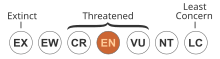
The tiger is listed as Endangered on the IUCN Red List. As of 2015, the global wild tiger population was estimated to number between 3,062 and 3,948 mature individuals, with most of the populations living in small isolated pockets. India currently hosts the largest tiger population. Major reasons for population decline are habitat destruction, habitat fragmentation and poaching. Tigers are also victims of human–wildlife conflict, particularly in range countries with a high human population density.
The tiger is among the most recognisable and popular of the world's charismatic megafauna. It featured prominently in the ancient mythology and folklore of cultures throughout its historic range, and continues to be depicted in modern films and literature, appearing on many flags, coats of arms and as mascots for sporting teams. The tiger is the national animal of India, Bangladesh, Malaysia and South Korea.
Etymology
The Middle English tigre and Old English tigras derive from Old French tigre, from Latin tigris. This was a borrowing of Classical Greek τίγρις 'tigris', a foreign borrowing of unknown origin meaning 'tiger' and the river Tigris.[4] The origin may have been the Persian word tigra meaning 'pointed or sharp', and the Avestan word tigrhi 'arrow', perhaps referring to the speed of the tiger's leap, although these words are not known to have any meanings associated with tigers.[5]
The generic name Panthera is derived from the Latin word panthera, and the Ancient Greek word πάνθηρ 'panther'.[6] The Sanskrit word पाण्डर pāṇḍ-ara means 'pale yellow, whitish, white'.[7]
Taxonomy and genetics
In 1758, Carl Linnaeus described the tiger in his work Systema Naturae and gave it the scientific name Felis tigris.[2] In 1929, the British taxonomist Reginald Innes Pocock subordinated the species under the genus Panthera using the scientific name Panthera tigris.[8][9]
Subspecies

Following Linnaeus's first descriptions of the species, several tiger specimens were described and proposed as subspecies.[11] The validity of several tiger subspecies was questioned in 1999. Most putative subspecies described in the 19th and 20th centuries were distinguished on basis of fur length and colouration, striping patterns and body size, hence characteristics that vary widely within populations. Morphologically, tigers from different regions vary little, and gene flow between populations in those regions is considered to have been possible during the Pleistocene. Therefore, it was proposed to recognize only two tiger subspecies as valid, namely P. t. tigris in mainland Asia, and P. t. sondaica in the Greater Sunda Islands.[12]
Results of craniological analysis of 111 tiger skulls from Southeast Asian range countries indicate that Sumatran tiger skulls differ from Indochinese and Javan tiger skulls, whereas Bali tiger skulls are similar in size to Javan tiger skulls. The authors proposed to classify the Sumatran and Javan tigers as distinct species, P. sumatrae and P. sondaica, with the Bali tiger as subspecies P. sondaica balica.[13]
In 2015, morphological, ecological, and molecular traits of all putative tiger subspecies were analysed in a combined approach. Results support distinction of the two evolutionary groups continental and Sunda tigers. The authors proposed recognition of only two subspecies, namely P. t. tigris comprising the Bengal, Malayan, Indochinese, South Chinese, Siberian and Caspian tiger populations, and P. t. sondaica comprising the Javan, Bali and Sumatran tiger populations. The authors also noted that this reclassification will affect tiger conservation management. The nominate subspecies P. t. tigris constitutes two clades:[14]
- a northern clade composed of the Siberian and Caspian tiger populations
- a southern clade composed of all other mainland populations.
One conservation specialist welcomed this proposal as it would make captive breeding programmes and future rewilding of zoo-born tigers easier. One geneticist was sceptical of this study and maintained that the currently recognised nine subspecies can be distinguished genetically.[15]
In 2017, the Cat Classification Task Force of the IUCN Cat Specialist Group revised felid taxonomy and recognized the tiger populations in continental Asia as P. t. tigris, and those in the Sunda Islands as P. t. sondaica.[16] This two-subspecies view has been largely rejected by researchers. Results of a 2018 whole-genome sequencing of 32 specimens support six monophyletic tiger clades corresponding with the living subspecies and indicate that the most recent common ancestor lived about 110,000 years ago.[17][18] The following tables are based on the classification of the species Panthera tigris provided in Mammal Species of the World.[11] It also reflects the classification used by the Cat Classification Task Force in 2017:


_832-714-(118).jpg)


Evolution

The tiger's closest living relatives were previously thought to be the Panthera species lion, leopard and jaguar. Results of genetic analysis indicate that about 2.88 million years ago, the tiger and the snow leopard lineages diverged from the other Panthera species, and that both may be more closely related to each other than to the lion, leopard and jaguar.[33][34] The geographic origin of the Panthera is most likely northern Central Asia or the Holarctic region. The tiger–snow leopard lineage dispersed in Southeast Asia during the Miocene.[35]
Panthera zdanskyi is considered to be a sister taxon of the modern tiger. It lived at the beginning of the Pleistocene about two million years ago, its fossil remains were excavated in Gansu of northwestern China. It was smaller and more "primitive", but functionally and ecologically similar to the modern tiger. It is disputed as to whether it had the striping pattern. Northwestern China is thought to be the origin of the tiger lineage. Tigers grew in size, possibly in response to adaptive radiations of prey species like deer and bovids, which may have occurred in Southeast Asia during the Early Pleistocene.[36]
Panthera tigris trinilensis lived about 1.2 million years ago and is known from fossils excavated near Trinil in Java.[37] The Wanhsien, Ngandong, Trinil, and Japanese tigers became extinct in prehistoric times.[38] Tigers reached India and northern Asia in the late Pleistocene, reaching eastern Beringia, Japan, and Sakhalin. Some fossil skulls are morphologically distinct from lion skulls, which could indicate tiger presence in Alaska during the last glacial period, about 100,000 years ago.[39]
In the Ille Cave on the island of Palawan, two articulated phalanx bones were found amidst an assemblage of other animal bones and stone tools. They were smaller than mainland tiger fossils, possibly due to insular dwarfism.[40] It has been speculated that the tiger parts were either imported from elsewhere, or that the tiger colonised Palawan from Borneo before the Holocene.[41][42] Fossil remains of tigers were also excavated in Sri Lanka, China, Japan and Sarawak dating to the Late Pliocene, Pleistocene and Early Holocene.[39][43] The Bornean tiger was apparently present in Borneo between the Late Pleistocene and the Holocene, but whether it went extinct in prehistoric or recent times has not been resolved.[43][44]
Results of a phylogeographic study indicate that all living tigers had a common ancestor 108,000 to 72,000 years ago.[26] The potential tiger range during the late Pleistocene and Holocene was predicted applying ecological niche modelling based on more than 500 tiger locality records combined with bioclimatic data. The resulting model shows a contiguous tiger range at the Last Glacial Maximum, indicating gene flow between tiger populations in mainland Asia. The Caspian tiger population was likely connected to the Bengal tiger population through corridors below elevations of 4,000 m (13,000 ft) in the Hindu Kush. The tiger populations on the Sunda Islands and mainland Asia were possibly separated during interglacial periods.[45]
The tiger's full genome sequence was published in 2013. It was found to have similar repeat composition to other cat genomes and an appreciably conserved synteny.[46]
Hybrids
Captive tigers were bred with lions to create hybrids called liger and tigon. They share physical and behavioural qualities of both parent species. Breeding hybrids is now discouraged due to the emphasis on conservation.[47] The liger is a cross between a male lion and a tigress. Ligers are typically between 10 and 12 ft (3.0 and 3.7 m) in length, and weigh between 800 and 1,000 lb (360 and 450 kg) or more.[48] Because the lion sire passes on a growth-promoting gene, but the corresponding growth-inhibiting gene from the female tiger is absent, ligers grow far larger than either parent species.[49]
The less common tigon is a cross between a lioness and a male tiger.[47] Because the male tiger does not pass on a growth-promoting gene and the lioness passes on a growth inhibiting gene, tigons are around the same size as their parents.[49] Some females are fertile and have occasionally given birth to litigons when mated to a male Asiatic lion.[50]
Description


The tiger has a muscular body with powerful forelimbs, a large head and a tail that is about half the length of its body. Its pelage is dense and heavy, and colouration varies between shades of orange and brown with white ventral areas and distinctive vertical black stripes that are unique in each individual.[51][24] Stripes are likely advantageous for camouflage in vegetation such as long grass with strong vertical patterns of light and shade.[52][53] The tiger is one of only a few striped cat species; it is not known why spotted patterns and rosettes are the more common camouflage pattern among felids.[54] The orangish colour may also aid in camouflage as the tiger's prey are dichromats, and thus may perceive the cat as green and blended in with the vegetation.[55]
A tiger's coat pattern is still visible when it is shaved. This is not due to skin pigmentation, but to the stubble and hair follicles embedded in the skin.[56] It has a mane-like heavy growth of fur around the neck and jaws and long whiskers, especially in males. The pupils are circular with yellow irises. The small, rounded ears have a prominent white spot on the back, surrounded by black.[24] These spots are thought to play an important role in intraspecific communication.[57]
The tiger's skull is similar to a lion's skull, with the frontal region usually less depressed or flattened, and a slightly longer postorbital region. The lion skull shows broader nasal openings. Due to the variation in skull sizes of the two species, the structure of the lower jaw is a reliable indicator for their identification.[20] The tiger has fairly stout teeth; its somewhat curved canines are the longest among living felids with a crown height of up to 90 mm (3.5 in).[24]
Size
There is notable sexual dimorphism between male and female tigers, with the latter being consistently smaller. The size difference between them is proportionally greater in the large tiger subspecies, with males weighing up to 1.7 times more than females. Males also have wider forepaw pads, enabling sex to be identified from tracks.[58] It has been hypothesised that body size of different tiger populations may be correlated with climate and be explained by thermoregulation and Bergmann's rule, or by distribution and size of available prey species.[24][59]
Generally, males vary in total length from 250 to 390 cm (8.2 to 12.8 ft) and weigh between 90 and 300 kg (200 and 660 lb) with skull length ranging from 316 to 383 mm (12.4 to 15.1 in). Females vary in total length from 200 to 275 cm (6.56 to 9.02 ft), weigh 65 to 167 kg (143 to 368 lb) with skull length ranging from 268 to 318 mm (0.879 to 1.043 ft). In either sex, the tail represents about 0.6 to 1.1 m (24 to 43 in) of the total length. The Bengal and Siberian tigers are amongst the tallest cats in shoulder height. They are also ranked among the biggest cats that have ever existed reaching weights of more than 300 kg (660 lb).[24] The tigers of the Sunda islands are smaller and less heavy than tigers in mainland Asia, rarely exceeding 142 kg (313 lb) in weight.[27]
Colour variations

There are three colour variants – white, golden and stripeless snow white – that now rarely occur in the wild due to the reduction of wild tiger populations, but continue in captive populations. The white tiger has white fur and sepia brown stripes. The golden tiger has a pale golden pelage with a blond tone and reddish-brown stripes. The snow white tiger is a morph with extremely faint stripes and a pale reddish-brown ringed tail. Both snow white and golden tigers are homozygous for CORIN gene mutations.[60] A black tiger is a colour variant due to pseudo-melanism. They have thick stripes close together so that the background colour is barely visible between stripes.[61]
The white tiger lacks pheomelanin (which creates the orange colour), and has dark sepia-brown stripes and blue eyes. This altered pigmentation is caused by a mutant gene that is inherited as an autosomal recessive trait, which is determined by a white locus. It is not an albino, as the black pigments are scarcely affected.[62][60] The mutation changes a single amino acid in the transporter protein SLC45A2. Both parents need to have the allele for whiteness to have white cubs.[63] Between the early and mid 20th century, white tigers were recorded and shot in the Indian states of Odisha, Bihar, Assam and in the area of Rewa, Madhya Pradesh. The local maharaja started breeding tigers in the early 1950s and kept a white male tiger together with its normal-coloured daughter; they had white cubs.[64] To preserve this recessive trait, only a few white individuals were used in captive breeding, which led to a high degree of inbreeding. Inbreeding depression is the main reason for many health problems of captive white tigers, including strabismus, stillbirth, deformities and premature death.[65] Other physical defects include cleft palate and scoliosis.[66]
The Tiger Species Survival Plan has condemned the breeding of white tigers, alleging they are of mixed ancestry and of unknown lineage. The genes responsible for white colouration are represented by 0.001% of the population. The disproportionate growth in numbers of white tigers points to inbreeding among homozygous recessive individuals. This would lead to inbreeding depression and loss of genetic variability.[67]
Distribution and habitat

The tiger historically ranged from eastern Turkey and Transcaucasia to the coast of the Sea of Japan, and from South Asia across Southeast Asia to the Indonesian islands of Sumatra, Java and Bali.[51] Since the end of the last glacial period, it was probably restricted by periods of deep snow lasting longer than six months.[68][69] Currently, it occurs in less than 6% of its historical range, as it has been extirpated from Southwest and Central Asia, large parts of Southeast and East Asia. It now mainly occurs in the Indian subcontinent, the Indochinese Peninsula, Sumatra and the Russian Far East. In China and Myanmar, breeding populations appear to rely on immigration from neighbouring countries while its status in the Korean Peninsula is unknown.[1][70]
The tiger is essentially associated with forest habitats.[43][71] Tiger populations thrive where populations of wild cervids, bovids and suids are stable.[72] Records in Central Asia indicate that it occurred foremost in Tugay riverine forests along the Atrek, Amu Darya, Syr Darya, Hari, Chu and Ili Rivers and their tributaries. In the Caucasus, it inhabited hilly and lowland forests.[20] Historical records in Iran are known only from the southern coast of the Caspian Sea and adjacent Alborz Mountains.[73] In the Amur-Ussuri region, it inhabits Korean pine and temperate broadleaf and mixed forests, where riparian forests provide food and water, and serve as dispersal corridors for both tiger and ungulates.[69][74] On the Indian subcontinent, it inhabits mainly tropical and subtropical moist broadleaf forests, moist evergreen forests, tropical dry forests and the swamp forests of the Sundarbans.[75] In the Eastern Himalayas, tigers were documented in temperate forest up to an elevation of 4,200 m (13,800 ft) in Bhutan and of 3,630 m (11,910 ft) in the Mishmi Hills.[76][77] In Thailand, it lives in deciduous and evergreen forests.[78] In Laos, 14 tigers were documented in semi-evergreen and evergreen forest interspersed with grassland in Nam Et-Phou Louey National Protected Area during surveys from 2013 to 2017.[79] In Sumatra, tiger populations range from lowland peat swamp forests to rugged montane forests.[80]
Behaviour and ecology


Social and daily activities
.jpg)
When not subject to human disturbance, the tiger is mainly diurnal.[81] It does not often climb trees but cases have been recorded.[52] It is a strong swimmer and often bathes in ponds, lakes and rivers, thus keeping cool in the heat of the day.[82] Individuals can cross rivers up to 7 km (4.3 mi) wide and can swim up to 29 km (18 mi) in a day.[83] During the 1980s, a tiger was observed frequently hunting prey through deep lake water in Ranthambhore National Park.[81]
The tiger is a long-ranging species, and individuals disperse over distances of up to 650 km (400 mi) to reach tiger populations in other areas.[84] Radio-collared tigers in Chitwan National Park started dispersing from their natal areas earliest at the age of 19 months. Four females dispersed between 0 and 43.2 km (0.0 and 26.8 mi), and 10 males between 9.5 and 65.7 km (5.9 and 40.8 mi). None of them crossed open cultivated areas that were more than 10 km (6.2 mi) wide, but moved through forested habitat.[85]
Adult tigers lead largely solitary lives. They establish and maintain territories but have much wider home ranges within which they roam. Resident adults of either sex generally confine their movements to their home ranges, within which they satisfy their needs and those of their growing cubs. Individuals sharing the same area are aware of each other's movements and activities.[86] The size of the home range mainly depends on prey abundance, geographic area and sex of the individual.[52][24] In India, home ranges appear to be 50 to 1,000 km2 (19 to 386 sq mi) while in Manchuria, they range from 500 to 4,000 km2 (190 to 1,540 sq mi). In Nepal, defended territories are recorded to be 19 to 151 km2 (7.3 to 58.3 sq mi) for males and 10 to 51 km2 (3.9 to 19.7 sq mi) for females.[83]
Young female tigers establish their first territories close to their mother's. The overlap between the female and her mother's territory reduces with time. Males, however, migrate further than their female counterparts and set out at a younger age to mark out their own area. A young male acquires territory either by seeking out an area devoid of other male tigers, or by living as a transient in another male's territory until he is older and strong enough to challenge the resident male. Young males seeking to establish themselves thereby comprise the highest mortality rate (30–35% per year) amongst adult tigers.[87]
To identify his territory, the male marks trees by spraying urine,[88][89] anal gland secretions, marking trails with feces and marking trees or the ground with their claws. Females also use these "scrapes", urine and fecal markings. Scent markings of this type allow an individual to pick up information on another's identity, sex and reproductive status. Females in oestrus will signal their availability by scent marking more frequently and increasing their vocalisations.[52]
Although for the most part avoiding each other, tigers are not always territorial and relationships between individuals can be complex. An adult of either sex will sometimes share its kill with others, even those who may not be related to them. George Schaller observed a male share a kill with two females and four cubs. Unlike male lions, male tigers allow females and cubs to feed on the kill before the male is finished with it; all involved generally seem to behave amicably, in contrast to the competitive behaviour shown by a lion pride.[90] Stephen Mills described a social feeding event in Ranthambore National Park:
Male tigers are generally more intolerant of other males within their territories than females are of other females. Territory disputes are usually solved by displays of intimidation rather than outright aggression. Several such incidents have been observed in which the subordinate tiger yielded defeat by rolling onto its back and showing its belly in a submissive posture.[91] Once dominance has been established, a male may tolerate a subordinate within his range, as long as they do not live in too close quarters.[87] The most aggressive disputes tend to occur between two males when a female is in oestrus, and sometimes results in the death of one of the males.[87][91]

Facial expressions include the "defense threat", where an individual bares its teeth, flattens its ears and its pupils enlarge. Both males and females show a flehmen response, a characteristic grimace, when sniffing urine markings, but flehmen is more often associated with males detecting the markings made by tigresses in oestrus. Like other Panthera, tigers roar, particularly in aggressive situations, during the mating season or when making a kill. There are two different roars: the "true" roar is made using the hyoid apparatus and forced through an open mouth as it progressively closes, and the shorter, harsher "coughing" roar is made with the mouth open and teeth exposed. The "true" roar can be heard at up to 3 km (1.9 mi) away and is sometimes emitted three or four times in succession. When tense, tigers will moan, a sound similar to a roar but more subdued and made when the mouth is partially or completely closed. Moaning can be heard 400 m (1,300 ft) away.[24] Chuffing—soft, low-frequency snorting similar to purring in smaller cats—is heard in more friendly situations.[92] Other vocal communications include grunts, woofs, snarls, miaows, hisses and growls.[24]
Hunting and diet
.jpg)

In the wild, tigers mostly feed on large and medium-sized mammals, particularly ungulates weighing 60–250 kg (130–550 lb). Range-wide, sambar deer, wapiti, barasingha and wild boar are significantly preferred. Tigers are capable of taking down larger prey like adult gaur[93] but will also opportunistically eat much smaller prey, such as monkeys, peafowl and other ground-based birds, hares, porcupines, and fish.[52] They also prey on other predators, including dogs, leopards, pythons, bears, and crocodiles.[94] Tigers generally do not prey on fully grown adult Asian elephants and Indian rhinoceros but incidents have been reported.[95][96][97] More often, it is the more vulnerable small calves that are taken.[98] When in close proximity to humans, tigers will also sometimes prey on such domestic livestock as cattle, horses, and donkeys. Although almost exclusively carnivorous, tigers will occasionally eat vegetation for dietary fibre such as fruit of the slow match tree.[94]

Tigers are thought to be mainly nocturnal predators,[71] but in areas where humans are absent, remote-controlled, hidden camera traps recorded them hunting in daylight.[99] They generally hunt alone and ambush their prey as most other cats do, overpowering them from any angle, using their body size and strength to knock the prey off balance. Successful hunts usually require the tiger to almost simultaneously leap onto its quarry, knock it over, and grab the throat or nape with its teeth.[83] Despite their large size, tigers can reach speeds of about 49–65 km/h (30–40 mph) but only in short bursts; consequently, tigers must be close to their prey before they break cover. If the prey senses the tiger's presence before this, the tiger usually abandons the hunt rather than chase prey or battle it head-on. Horizontal leaps of up to 10 m (33 ft) have been reported, although leaps of around half this distance are more typical. One in 2 to 20 hunts, including stalking near potential prey, ends in a successful kill.[83][71]

When hunting larger animals, tigers prefer to bite the throat and use their powerful forelimbs to hold onto the prey, often simultaneously wrestling it to the ground. The tiger remains latched onto the neck until its target dies of strangulation.[90] By this method, gaurs and water buffaloes weighing over a ton have been killed by tigers weighing about a sixth as much.[100] Although they can kill healthy adults, tigers often select the calves or infirm of very large species.[101] Healthy adult prey of this type can be dangerous to tackle, as long, strong horns, legs and tusks are all potentially fatal to the tiger. No other extant land predator routinely takes on prey this large on its own.[20][102]
With smaller prey, such as monkeys and hares, the tiger bites the nape, often breaking the spinal cord, piercing the windpipe, or severing the jugular vein or common carotid artery.[103] Though rarely observed, some tigers have been recorded to kill prey by swiping with their paws, which are powerful enough to smash the skulls of domestic cattle,[94] and break the backs of sloth bears.[104]
After killing their prey, tigers sometimes drag it to conceal it in vegetative cover, usually pulling it by grasping with their mouths at the site of the killing bite. This, too, can require great physical strength. In one case, after it had killed an adult gaur, a tiger was observed to drag the massive carcass over a distance of 12 m (39 ft). When 13 men simultaneously tried to drag the same carcass later, they were unable to move it.[83] An adult tiger can go for up to two weeks without eating, then gorge on 34 kg (75 lb) of flesh at one time. In captivity, adult tigers are fed 3 to 6 kg (6.6 to 13.2 lb) of meat a day.[83]
Enemies and competitors

Tigers usually prefer to eat self-killed prey, but eat carrion in times of scarcity and also steal prey from other large carnivores. Although predators typically avoid one another, if a prey item is under dispute or a serious competitor is encountered, displays of aggression are common. If these are not sufficient, the conflicts may turn violent; tigers may kill or even prey on competitors such as leopards, dholes, striped hyenas, wolves, bears, pythons, and mugger crocodiles on occasion.[29][104][105][106][107] Attacks on smaller predators, such as badgers, lynxes, and foxes, are almost certainly predatory. Crocodiles, bears, and large packs of dholes may win conflicts against tigers and, in the cases of crocodiles and bears, even can kill them.[29][20][108][109]
The considerably smaller leopard avoids competition from tigers by hunting at different times of the day and hunting different prey.[110] In India's Nagarhole National Park, most prey selected by leopards were from 30 to 175 kg (66 to 386 lb) against a preference for prey weighing over 176 kg (388 lb) in the tigers. The average prey weight in the two respective big cats in India was 37.6 kg (83 lb) against 91.5 kg (202 lb).[111][112] With relatively abundant prey, tigers and leopards were seen to successfully coexist without competitive exclusion or interspecies dominance hierarchies that may be more common to the African savanna, where the leopard exists with the lion.[111] Golden jackals may feed on the tiger's kills.[113] Tigers appear to inhabit the deep parts of a forest while smaller predators like leopards and dholes are pushed closer to the fringes.[114]
Reproduction and life cycle


The tiger mates all year round, but most cubs are born between March and June, with a second peak in September. Gestation ranges from 93 to 114 days, with an average of 103 to 105 days. A female is only receptive for three to six days.[115] Mating is frequent and noisy during that time.[51] The female gives birth in a sheltered location such as in tall grass, in a dense thicket, cave or rocky crevice. The father generally takes no part in rearing.[20] Litters consist of two or three cubs, rarely as many as six. Cubs weigh from 780 to 1,600 g (1.72 to 3.53 lb) each at birth, and are born with eyes closed. They open their eyes when they are six to 14 days old.[115] Their milk teeth break through at the age of about two weeks. They start to eat meat at the age of eight weeks. At around this time, females usually shift them to a new den.[51] They make short ventures with their mother, although they do not travel with her as she roams her territory until they are older. Females lactate for five to six months.[115] Around the time they are weaned, they start to accompany their mother on territorial walks and are taught how to hunt.[81]
A dominant cub emerges in most litters, usually a male. The dominant cub is more active than its siblings and takes the lead in their play, eventually leaving its mother and becoming independent earlier.[81] The cubs start hunting on their own earliest at the age of 11 months, and become independent around 18 to 20 months of age.[90] They separate from their mother at the age of two to two and a half years, but continue to grow until the age of five years.[51] Young females reach sexual maturity at three to four years, whereas males at four to five years.[20] Unrelated wandering male tigers often kill cubs to make the female receptive, since the tigress may give birth to another litter within five months if the cubs of the previous litter are lost. The mortality rate of tiger cubs is about 50% in the first two years. Few other predators attack tiger cubs due to the diligence and ferocity of the mother. Apart from humans and other tigers, common causes of cub mortality are starvation, freezing, and accidents.[102] Generation length of the tiger is about eight years.[116] The oldest recorded captive tiger lived for 26 years.[83]
Occasionally, male tigers participate in raising cubs, usually their own, but this is extremely rare and not always well understood. In May 2015, Amur tigers were photographed by camera traps in the Sikhote-Alin Nature Reserve. The photos show a male Amur tiger pass by, followed by a female and three cubs within the span of about two minutes.[117] In Ranthambore, a male Bengal tiger raised and defended two orphaned female cubs after their mother had died of illness. The cubs remained under his care, he supplied them with food, protected them from his rival and sister, and apparently also trained them

No comments: