Pizza (Italian: [ˈpittsa], Neapolitan: [ˈpittsə]) is an Italian dish consisting of a usually round, flattened base of leavened wheat-based dough topped with tomatoes, cheese, and often various other ingredients (such as anchovies, mushrooms, onions, olives, pineapple, meat, etc.), which is then baked at a high temperature, traditionally in a wood-fired oven.[1] A small pizza is sometimes called a pizzetta. A person who makes pizza is known as a pizzaiolo.


In Italy, pizza served in formal settings, such as at a restaurant, is presented unsliced, and is eaten with the use of a knife and fork.[2][3] In casual settings, however, it is cut into wedges to be eaten while held in the hand.
The term pizza was first recorded in the 10th century in a Latin manuscript from the Southern Italian town of Gaeta in Lazio, on the border with Campania.[4] Modern pizza was invented in Naples, and the dish and its variants have since become popular in many countries.[5] It has become one of the most popular foods in the world and a common fast food item in Europe and North America, available at pizzerias (restaurants specializing in pizza), restaurants offering Mediterranean cuisine, and via pizza delivery.[5][6] Many companies sell ready-baked frozen pizzas to be reheated in an ordinary home oven.
The Associazione Verace Pizza Napoletana (lit. True Neapolitan Pizza Association) is a non-profit organization founded in 1984 with headquarters in Naples that aims to promote traditional Neapolitan pizza.[7] In 2009, upon Italy's request, Neapolitan pizza was registered with the European Union as a Traditional Speciality Guaranteed dish,[8][9] and in 2017 the art of its making was included on UNESCO's list of intangible cultural heritage.[10]
Etymology

The word "pizza" first appeared in a Latin text from the central Italian town of Gaeta, then still part of the Byzantine Empire, in 997 AD; the text states that a tenant of certain property is to give the bishop of Gaeta duodecim pizze ("twelve pizzas") every Christmas Day, and another twelve every Easter Sunday.[4][11]
Suggested etymologies include:
- Byzantine Greek and Late Latin pitta > pizza, cf. Modern Greek pitta bread and the Apulia and Calabrian (then Byzantine Italy) pitta,[12] a round flat bread baked in the oven at high temperature sometimes with toppings. The word pitta can in turn be traced to either Ancient Greek πικτή (pikte), "fermented pastry", which in Latin became "picta", or Ancient Greek πίσσα (pissa, Attic πίττα, pitta), "pitch",[13][14] or πήτεα (pḗtea), "bran" (πητίτης pētítēs, "bran bread").[15]
- The Etymological Dictionary of the Italian Language explains it as coming from dialectal pinza "clamp", as in modern Italian pinze "pliers, pincers, tongs, forceps". Their origin is from Latin pinsere "to pound, stamp".[16]
- The Lombardic word bizzo or pizzo meaning "mouthful" (related to the English words "bit" and "bite"), which was brought to Italy in the middle of the 6th century AD by the invading Lombards.[4][17] The shift b>p could be explained by the High German consonant shift, and it has been noted in this connection that in German the word Imbiss means "snack".
History


Foods similar to pizza have been made since the Neolithic Age.[18] Records of people adding other ingredients to bread to make it more flavorful can be found throughout ancient history. In the 6th century BC, the Persian soldiers of the Achaemenid Empire during the rule of Darius the Great baked flatbreads with cheese and dates on top of their battle shields[19][20] and the ancient Greeks supplemented their bread with oils, herbs, and cheese.[21][22] An early reference to a pizza-like food occurs in the Aeneid, when Celaeno, queen of the Harpies, foretells that the Trojans would not find peace until they are forced by hunger to eat their tables (Book III). In Book VII, Aeneas and his men are served a meal that includes round cakes (like pita bread) topped with cooked vegetables. When they eat the bread, they realize that these are the "tables" prophesied by Celaeno.[23]
Modern pizza evolved from similar flatbread dishes in Naples, Italy, in the 18th or early 19th century.[24] Prior to that time, flatbread was often topped with ingredients such as garlic, salt, lard, and cheese. It is uncertain when tomatoes were first added and there are many conflicting claims.[24] Until about 1830, pizza was sold from open-air stands and out of pizza bakeries.
A popular contemporary legend holds that the archetypal pizza, pizza Margherita, was invented in 1889, when the Royal Palace of Capodimonte commissioned the Neapolitan pizzaiolo (pizza maker) Raffaele Esposito to create a pizza in honor of the visiting Queen Margherita. Of the three different pizzas he created, the Queen strongly preferred a pizza swathed in the colors of the Italian flag — red (tomato), green (basil), and white (mozzarella). Supposedly, this kind of pizza was then named after the Queen,[25] although later research cast doubt on this legend.[26] An official letter of recognition from the Queen's "head of service" remains on display in Esposito's shop, now called the Pizzeria Brandi.[27]
Pizza was brought to the United States with Italian immigrants in the late nineteenth century[28] and first appeared in areas where Italian immigrants concentrated. The country's first pizzeria, Lombardi's, opened in 1905.[29] Following World War II, veterans returning from the Italian Campaign, who were introduced to Italy's native cuisine, proved a ready market for pizza in particular.[30]
Preparation
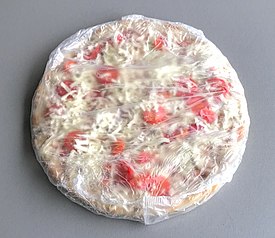
Pizza is sold fresh or frozen, and whole or as portion-size slices or pieces. Methods have been developed to overcome challenges such as preventing the sauce from combining with the dough and producing a crust that can be frozen and reheated without becoming rigid. There are frozen pizzas with raw ingredients and self-rising crusts.
Another form of uncooked pizza is available from take and bake pizzerias. This pizza is assembled in the store, then sold to customers to bake in their own ovens. Some grocery stores sell fresh dough along with sauce and basic ingredients, to complete at home before baking in an oven.
- Pizza preparation




_First_Class_Association_prepare_and_put_toppings_on_pizzas_in_the_galley_as_part_of_a_special_dinner_prepared_for_the_crew.jpg)

Cooking
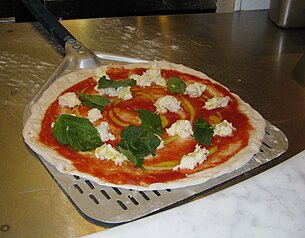
In restaurants, pizza can be baked in an oven with stone bricks above the heat source, an electric deck oven, a conveyor belt oven, or, in the case of more expensive restaurants, a wood or coal-fired brick oven. On deck ovens, pizza can be slid into the oven on a long paddle, called a peel, and baked directly on the hot bricks or baked on a screen (a round metal grate, typically aluminum). Prior to use, a peel may be sprinkled with cornmeal to allow pizza to easily slide onto and off of it.[31] When made at home, it can be baked on a pizza stone in a regular oven to reproduce the effect of a brick oven. Cooking directly in a metal oven results in too rapid heat transfer to the crust, burning it.[32] Aficionado home-chefs sometimes use a specialty wood-fired pizza oven, usually installed outdoors. Dome-shaped pizza ovens have been used for centuries,[33] which is one way to achieve true heat distribution in a wood-fired pizza oven. Another option is grilled pizza, in which the crust is baked directly on a barbecue grill. Greek pizza, like Chicago-style pizza, is baked in a pan rather than directly on the bricks of the pizza oven.
When it comes to preparation, the dough and ingredients can be combined on any kind of table. With mass production of pizza, the process can be completely automated. Most restaurants still use standard and purpose-built pizza preparation tables. Pizzerias nowadays can even opt for high tech pizza preparation tables that combine mass production elements with traditional techniques.[34]
- Pizza cooking




Crust

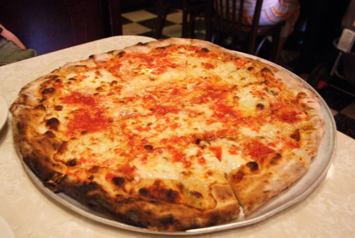
The bottom of the pizza, called the "crust", may vary widely according to style, thin as in a typical hand-tossed Neapolitan pizza or thick as in a deep-dish Chicago-style. It is traditionally plain, but may also be seasoned with garlic or herbs, or stuffed with cheese. The outer edge of the pizza is sometimes referred to as the cornicione.[35] Pizza dough often contains sugar, both to help its yeast rise and enhance browning of the crust.[36]
Dipping sauce specifically for pizza was invented by American pizza chain Papa John's Pizza in 1984 and has since become popular when eating pizza, especially the crust.[37]
Cheese

Mozzarella is commonly used on pizza, with the highest quality buffalo mozzarella produced in the surroundings of Naples.[38] Eventually, other cheeses were used well as pizza ingredients, particularly Italian cheeses including provolone, pecorino romano, ricotta, and scamorza. Less expensive processed cheeses or cheese analogues have been developed for mass-market pizzas to produce desirable qualities like browning, melting, stretchiness, consistent fat and moisture content, and stable shelf life. This quest to create the ideal and economical pizza cheese has involved many studies and experiments analyzing the impact of vegetable oil, manufacturing and culture processes, denatured whey proteins, and other changes in manufacture. In 1997, it was estimated that annual production of pizza cheese was 1 million metric tons (1,100,000 short tons) in the U.S. and 100,000 metric tons (110,000 short tons) in Europe.[39]

Varieties
Italy
Authentic Neapolitan pizza (pizza napoletana) is made with San Marzano tomatoes, grown on the volcanic plains south of Mount Vesuvius, and mozzarella di bufala Campana, made with milk from water buffalo raised in the marshlands of Campania and Lazio.[40] This mozzarella is protected with its own European protected designation of origin.[40] Other traditional pizzas include pizza alla marinara, which is topped with marinara sauce and is supposedly the most ancient tomato-topped pizza,[41] pizza capricciosa, which is prepared with mozzarella cheese, baked ham, mushroom, artichoke, and tomato,[42] and pizza pugliese, prepared with tomato, mozzarella, and onions.[43]
A popular variant of pizza in Italy is Sicilian pizza (locally called sfincione or sfinciuni),[44][45] a thick-crust or deep-dish pizza originating during the 17th century in Sicily: it is essentially a focaccia that is typically topped with tomato sauce and other ingredients. Until the 1860s, sfincione was the type of pizza usually consumed in Sicily, especially in the Western portion of the island.[46] Other variations of pizzas are also found in other regions of Italy, for example pizza al padellino or pizza al tegamino, a small-sized, thick-crust, deep-dish pizza typically served in Turin, Piedmont.[47][48][49]
United States

The first pizzeria in the U.S. was opened in New York City's Little Italy in 1905.[50] Common toppings for pizza in the United States include anchovies, ground beef, chicken, ham, mushrooms, olives, onions, peppers, pepperoni, pineapple, salami, sausage, spinach, steak, and tomatoes. Distinct regional types developed in the 20th century, including Buffalo,[51] California, Chicago, Detroit, Greek, New Haven, New York, and St. Louis styles.[52] These regional variations include deep-dish, stuffed, pockets, turnovers, rolled, and pizza-on-a-stick, each with seemingly limitless combinations of sauce and toppings.
Thirteen percent of the United States population consumes pizza on any given day.[53] Pizza chains such as Domino's Pizza, Pizza Hut, and Papa John's, pizzas from take and bake pizzerias, and chilled or frozen pizzas from supermarkets make pizza readily available nationwide.
Argentina
Argentina, and more specifically Buenos Aires, received a massive Italian immigration at the turn of the 19th century. Immigrants from Naples and Genoa opened the first pizza bars, though over time Spanish residents came to own the majority of the pizza businesses.
Standard Argentine pizza has a thicker crust, called "media masa" (half dough) than traditional Italian style pizza and includes more cheese. Argentine gastronomy tradition, served pizza with fainá, which is a Genovese chick pea-flour dough placed over the piece of pizza, and moscato wine. The most popular variety of pizza is called "muzzarella" (mozzarella), similar to Neapolitan pizza (bread, tomato sauce and cheese) but made with a thicker "media masa" crust, triple cheese and tomato sauce, usually also with olives. It can be found in nearly every corner of the country; Buenos Aires is considered the city with the most pizza bars by person of the world.[54] Other popular varieties include jam, tomato slices, red pepper and longaniza. Two Argentine-born varieties of pizza with onion, are also very popular: fugazza with cheese and fugazzetta. The former one consists in a regular pizza crust topped with cheese and onions; the later has the cheese between two pizza crusts, with onions on top

No comments: